
Blessings to All:
By: Richard PICKARD
“Blessed are you when people insult you, persecute you and falsely say all kinds of evil against you because of me. Rejoice and be glad, because great is your reward in heaven, for in the same way they persecuted the prophets who were before you.” — Matthew 5:11–12
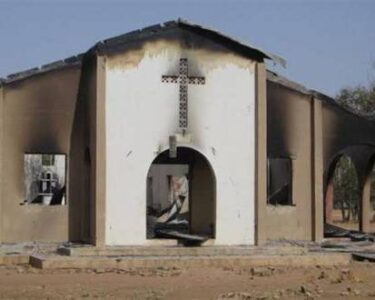
As I contemplate what to write for September, my mind drifts towards all the suffering of the world. The killings and murders of people who want to be free from religious persecution. We see reports of the many thousands upon thousands of people in Nigeria, Iran, N Korea who have undergone persecution and death because they believe in Christianity.
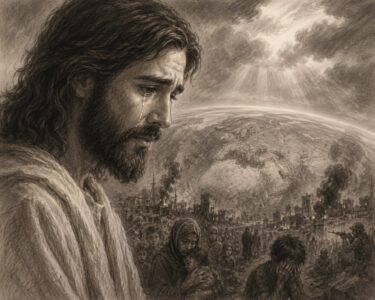
The evil that is upon the earth is championed by Satan and all of his earthly followers who seek the destruction of truth and the constant forcing of lies and half truths upon all of humankind.
“Man’s inhumanity to man makes countless thousands mourn.” Robert Burns wrote that line more than two centuries ago, grieving over the cruelties of his own age. He could not have known how many more centuries it would need to hold true.
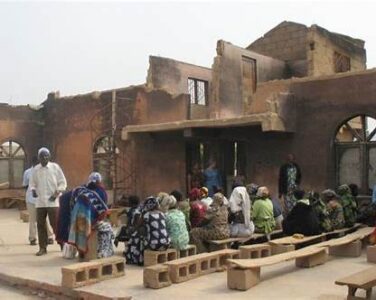
[1]This year, in Benue State, Nigeria, families gathered in a farming village were shot and burned to death over four hours, by men who came to kill them, because they were Christian. [2]In Iran, in the dead of a January winter, thousands of ordinary citizens — students, shopkeepers, mothers, teenagers — were killed in the streets for the crime of wanting to be free.
Many of you reading this don’t need me to tell you it’s real — especially the many of you in Nigeria who read our Newsletter each month. You have lived it, buried someone because of it, or held a family member’s hand through what came after. This newsletter reaches households across many countries, and I know that for some of you, “Man’s Inhumanity to Man” isn’t a line from an old poem. It’s real life.
The Weight of It
News reports citing the numbers killed can numb us. But they are also one way we refuse to let the dead become invisible. In Nigeria, monitoring groups documented roughly 3,490 Christians killed for their faith in the past year alone — among the highest tolls of any nation on earth, adding to a wound that has stayed open since 2009. The key event was the Boko Haram uprising in July 2009. Boko Haram had existed earlier, but in July it launched a major rebellion across northeastern Nigeria. Boko Haram’s leader, Mohammed Yusuf, was captured and killed in police custody.
Instead of disappearing, Boko Haram reorganized under Abubakar Shekau and became substantially more violent. Beginning around 2010–2011, it increasingly carried out bombings, assassinations, church attacks, and massacres. Christians became one of its explicit targets.
In Iran this past winter, a government crackdown on peaceful protesters — many simply demanding freedom from a regime that polices belief itself — killed thousands more. Independent monitors have confirmed over 7,000 names one by one; the true number is almost certainly higher, hidden behind a total shutdown of phones and internet the regime imposed specifically so the world could not see.
These are not identical tragedies. One is the deliberate killing of Christians because they are Christian. The other is a government turning its weapons on its own citizens for demanding freedom — freedom that, by its nature, includes freedom of conscience. But they share a root as old as Cain and Abel: the conviction, somewhere in the human heart, that another person’s life matters less than our own.
What It Has Never Taken
Here is what three decades spent studying violence for a living has taught me: cruelty can take a life. It cannot take what a life was made for. We are loved by God and hated by Satan and his earthly followers.
Those who survive are hurt in the deepest part of their souls. They are left to bury their families, rebuild their lives, and pray for strength against those who can kill the body, but cannot kill the soul. Many Catholic priests stay in these villages of destruction and death. They do not abandon their people.
Priests kept saying Mass in villages under open threat. Congregations rebuilt burned churches stone by stone rather than let hatred have the final word. In Iran, protesters who knew exactly what could happen marched anyway, because they had decided a life lived in fear wasn’t a life worth calling free.
What We Owe Each Other
If you are reading this in Lagos or Kaduna, in Accra, in Baghdad or Erbil — you already understand all of this better than I ever could from a desk in Texas.
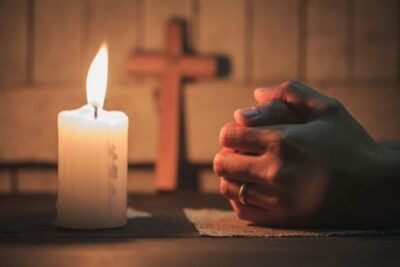 Please pray specifically, not generally — for those who are suffering and too often forgotten in our prayers. We naturally pray for our families, for the people we know and love. But our prayers should not end there.
If we truly believe that we are all children of God, then the suffering person thousands of miles away is not a stranger. He is our brother. She is our sister. Their children are as precious to God as our own.
Perhaps that is what we owe each other most: to remember one another, to pray for one another, and never to become so accustomed to another person’s suffering that we simply look away.
And for those of us fortunate enough to live somewhere quieter this year, remember: our comfort is not evidence of God’s favor, and someone else’s suffering is not evidence of His absence. It is evidence only of what people, given power and permission, are still capable of doing to one another. It is a call — not a guilt trip, a call — to use whatever voice, means, and prayer we have on behalf of the people on this very mailing list living inside these headlines right now.
A Closing Word
Man’s inhumanity to man is real. It has a body count, and it has names, and some of those names belong to people some of you loved. But it has never had the final word. It never will.
Every martyr, every survivor, every congregation that rebuilds instead of scatters, is proof of that — proof older than Burns, older than any of the headlines above, as old as a Roman cross, where Jesus gave His life for us. Those who caused His death thought they had settled the matter once and for all.
But three days later, the true Light of the World — the Truth — rose from the dead, and His promise to those who follow Him could not be silenced.
The blood of millions who would die because they believed in Him became the seed of a Church that Christ promised the gates of Hell would not overcome.
We mourn with you. We will not look away from you. And we will keep telling the truth about what is happening to you — because silence has always been the one thing this kind of violence depends on most. Please pray for all victims, all over the world who suffer, are killed and terrorized by Satan and his earthly followers.
[1] https://lightmagazine.ca/open-doors-world-watch-list-2026/
[2] https://www.npr.org/2026/01/27/nx-s1-5689793/6-126-iran-crackdown-protests-death-toll
Throughout Scripture, we see something wonderful about God: He never stops reaching out to His people. When they needed direction, He taught them; when they wandered, He patiently called them back; when they were frightened, He reassured them. And when the fullness of time had come, He sent His Son.
Three remarkable events in Scripture took place upon mountains—Mount Sinai, Mount Carmel, and the Mount of the Transfiguration. They happened centuries apart, yet together they reveal a beautiful progression in God’s plan. On Sinai we find Moses and the Law; on Carmel, Elijah and the Prophets; and on the Mount of Transfiguration, Moses and Elijah appear together with Jesus Christ. There is a reason.
Moses and Elijah — God Teaches and Calls His People Home
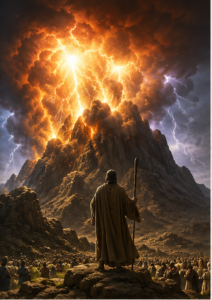
When Moses ascended Mount Sinai, the glory of the Lord settled upon the mountain. “The cloud covered it for six days, and on the seventh day he called to Moses from the midst of the cloud” (Exodus 24:16). Moses remained there forty days and forty nights, receiving the commandments by which God’s people were to live. These were more than rules; they were part of God’s covenant with a people He loved, teaching His children how to live in relationship with Him and with one another.
When Moses later descended, his face shone because he had been speaking with God. The people were afraid to approach him, and he eventually placed a veil over his face. Moses reflected the glory of God; the glory did not originate with Moses. He had stood in God’s presence and reflected His light.
Generations later, God’s people wandered. During Elijah’s time many Israelites had turned toward Baal, a Canaanite deity associated with storms, rain and fertility. Baal worship had its priests, altars, sacrifices and rituals, but Israel had entered into a covenant with the one true God: “You shall not have other gods beside me” (Exodus 20:3).
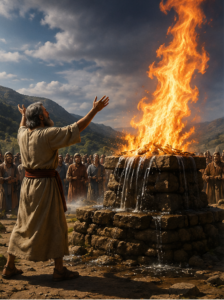
Yet even when His people turned away, God did not abandon them. On Mount Carmel Elijah challenged Israel: “If the LORD is God, follow him; if Baal, follow him” (1 Kings 18:21). A sacrifice was prepared and, at Elijah’s direction, drenched repeatedly with water. Then Elijah prayed: “Answer me, LORD, answer me, that this people may know that you, LORD, are God and that you have turned their hearts back” (1 Kings 18:37).
That prayer reveals the heart of the event. God was not merely demonstrating His power over Baal; He was calling His children home. Fire came down and consumed the sacrifice, wood, stones and even the water, and the people cried, “The LORD is God! The LORD is God!” They had wandered from Him, but God had not forgotten them.
The Mountain of the Transfiguration
Centuries later Matthew begins another mountaintop event with familiar words: “After six days Jesus took Peter, James, and John his brother, and led them up a high mountain by themselves” (Matthew 17:1). At Sinai the cloud had covered the mountain for six days before God called Moses from the cloud; now, after six days, Jesus leads three Apostles up another mountain.
There Jesus is transfigured before them: “His face shone like the sun and his clothes became white as light” (Matthew 17:2). Suddenly Moses and Elijah appear—Moses, the great figure of the Law, and Elijah, the great representative of the Prophets. Luke then gives us a remarkable detail: they spoke with Jesus about “his departure, which he was about to bring to fulfillment at Jerusalem” (Luke 9:31). The Greek word translated “departure” is exodos—Exodus.
Moses, who had led God’s people in the great Exodus from slavery in Egypt, now stands beside Jesus discussing the Exodus Jesus was about to accomplish through His Passion, Death and Resurrection. The first Exodus delivered God’s people from slavery in Egypt; through Christ would come a far greater deliverance—from sin and death and toward eternal life.
Here we also see a beautiful difference between Sinai and the Transfiguration. Moses’ face shone because he had been in God’s presence, but on the mountain Jesus Himself shines, His face becoming “like the sun.” For a brief moment Peter, James and John are permitted to glimpse His divine glory.
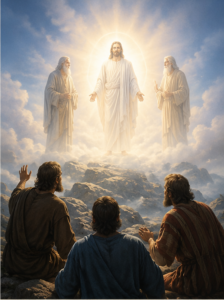
Then a cloud overshadows them and the Father’s voice is heard: “This is my beloved Son, with whom I am well pleased; listen to him” (Matthew 17:5). Moses had brought God’s Law, and Elijah and the prophets had called God’s people back to Him. Now the Father points to Jesus: “Listen to Him.” As Jesus had already said, “I have come not to abolish but to fulfill” (Matthew 5:17). The Law was not being discarded and the Prophets were not being forgotten; they were being fulfilled in Christ.
The Meaning of Forty
There is another thread connecting Moses, Elijah and Jesus—the number forty. Moses remained upon Sinai forty days and forty nights in the presence of God. Elijah, strengthened by food God provided, traveled forty days and forty nights to Horeb, the mountain of God (1 Kings 19:8). Jesus Himself fasted forty days and forty nights in the wilderness before beginning His public ministry.
There is also another forty we sometimes overlook. After Jesus accomplished the “Exodus” spoken of at the Transfiguration—after His Passion, Death and Resurrection—He did not immediately leave His disciples. Acts tells us that He “presented himself alive to them by many proofs after he had suffered, appearing to them during forty days and speaking about the kingdom of God” (Acts 1:3).
Moses spent forty days upon the mountain receiving from God; Elijah traveled forty days toward the mountain of God; and the risen Jesus spent forty days giving to His Apostles—teaching them about the Kingdom and preparing them to carry His Gospel into the world. Once again, Moses and Elijah point us toward Christ.
Jesus Remained
At the Transfiguration Peter, James and John became frightened and fell to the ground. Jesus did not scold them for being afraid. He came to them, touched them and said, “Rise, and do not be afraid” (Matthew 17:7). Think of the tenderness of that moment: the One whose face had just shone like the sun reaches down and touches His frightened friends.
When they raised their eyes, Moses and Elijah were gone. Jesus remained. Luke describes it with beautiful simplicity: “When the voice had spoken, Jesus was found alone” (Luke 9:36).
Perhaps this is the key to the three mountains. On Sinai, God lovingly taught His people and gave them His Law. On Carmel, when His people wandered, God patiently called their hearts back to Him. On the Mount of Transfiguration, the Law and the Prophets stood beside the One toward whom they had been pointing all along. Then the Father spoke: “This is my beloved Son…listen to Him.” When the cloud lifted, there was Jesus alone.
There is a tenderness running through all these events that we should not miss. God’s people did not always understand Him. They wandered, doubted and sometimes turned away, yet God continued to reach for them—and He continues reaching for us.
The Apostles would soon see Jesus arrested, beaten and crucified, and the glory they had witnessed on the mountain might have seemed very far away. But the glory was still there. After the darkness of Calvary came the Resurrection, and for forty days Jesus remained with His disciples, patiently teaching and preparing them for their mission.
There will also be times in our lives when God’s presence seems very clear and other times when troubles make Him difficult to see. But Christ has not left us. The same Jesus who reached down and touched His frightened Apostles and said, “Do not be afraid,” remains with His Church and with us today.
From Sinai, to Carmel, to the Mount of Transfiguration, and finally through the Cross and Resurrection, we see the same loving God patiently leading His children—teaching them, calling them back, preparing them, and finally giving them His Son.
When the cloud lifted, Moses and Elijah were gone. Jesus remained.
Perhaps that is where God has been patiently leading His children all along—to His Son.
When Catholics speak of the Immaculate Conception, we are not speaking of the conception of Jesus. We mean that Mary herself, from the first moment of her conception, was preserved by God’s grace from original sin. She was not divine and did not save herself. She was saved by Jesus Christ in an extraordinary way—His saving grace preserved her before sin touched her soul.
The foundation for understanding this reaches back to Genesis. After Adam and Eve sinned, God said to the serpent:
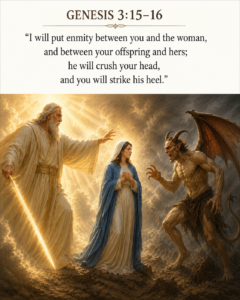
Christians have long understood this as the first biblical promise of the Savior’s victory over Satan. But notice that God speaks not only of the Savior; He also speaks of “the woman.” There would be enmity—complete opposition—between the serpent and the woman. Catholics see Mary as this woman, whose Son would ultimately defeat Satan. If Christ is completely victorious over sin, it is fitting that the woman chosen to give Him His human nature would, by His grace, be preserved from original sin.
Consider the logic of the Incarnation. God could have entered the world in any manner He chose. Instead, He chose to have a mother. For nine months the Son of God lived beneath Mary’s heart. From her He received His human flesh. She carried Him, gave birth to Him, fed Him, protected Him and loved Him. The eternal Son of God called this woman Mother.
Would it be unreasonable to believe that God specially prepared her for this unique calling? In the Old Testament, the Ark of the Covenant was sacred because it carried things associated with God’s covenant. Mary carried something infinitely greater: God the Son Himself. Catholics therefore see Mary as the New Ark of the Covenant—not because Mary is God, but because God chose to dwell within her.
But didn’t Mary need a Savior? Absolutely. Mary herself says, “My spirit rejoices in God my Savior.” (Luke 1:47) Imagine one person falling into a deep pit and being rescued, while another is stopped from falling into it. Both have been saved. Catholic teaching is that Christ saved Mary in the second way. She was preserved from original sin through the merits of Jesus Christ.
When Gabriel comes to Mary, he greets her: “Hail, full of grace, the Lord is with you.” — Luke 1:28
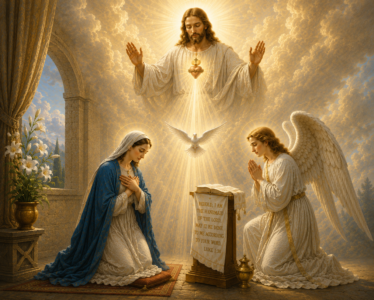
Gabriel, sent from God, greets Mary as “Full of Grace”. Thereby confirming, she is without sin…even original sin.
Then Mary gives her great response of faith: “Behold, I am the handmaid of the Lord. May it be done to me according to your word.” (Luke 1:38)
There is a beautiful contrast here. The first woman, Eve listened to the serpent and disobeyed; Mary listened to God and obeyed. Through Eve came the tragedy of the Fall. Through Mary’s willing yes came Jesus Christ, the Savior. This is why early Christians saw Mary as the New Eve. This is also why Catholics honor Mary but do not worship her. Worship belongs to God alone—Father, Son and Holy Spirit. Scripture itself tells us that Mary said, “From now on all generations will call me blessed.” (Luke 1:48) Catholics simply take those words seriously.
Every honor given to Mary ultimately points toward her Son. If Mary is blessed, God blessed her. If she is holy, God’s grace made her holy. If she is Mother of God, it is because Jesus is God. If she was preserved from original sin, it was because of the saving power of Jesus Christ.
And then we come to Calvary. Mary stands beneath the Cross. The child she once held in her arms is now crucified before her. The hands she once held as He learned to walk are pierced. She cannot remove the nails or take away His suffering. She can only remain beside her Son and love Him. From the Cross Jesus says to the beloved disciple:
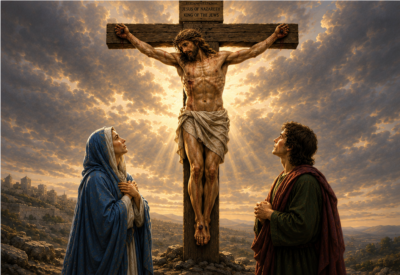
“Woman, behold, your son.” Then He said to the disciple, “Behold, your mother.” — John 19:26–27
Among the various Christian traditions, there is sometimes a misunderstanding about the place of Mary in the Catholic faith. Because Catholics pray for Mary’s intercession, celebrate her feast days, place her image in our churches, and speak of her with love and reverence, some Christians may see these practices as worship. But that has never been the teaching of the Catholic Church.
Catholics do not worship Mary; we honor her. Worship belongs to God alone—Father, Son, and Holy Spirit.
Consider the example of Jesus Himself. Jesus perfectly fulfilled the commandments of God, including: “Honor your father and your mother.” He perfectly honored His heavenly Father, and He also loved and honored Mary, His earthly mother.
Mary’s special place comes not from being divine—she is not—but from what God chose her to be: the mother of Jesus Christ. Scripture itself tells us that Mary said, “From now on all ages call me blessed” (Luke 1:48).
If we are called to follow Christ, should we not also follow His example in honoring His mother? We do not place Mary above Jesus. We honor Mary because of Jesus—because God chose her, because she said yes to Him, and because through her Christ entered the world.
To honor Mary does not take glory away from Jesus. Properly understood, it points us toward Him.
Are we not called to follow Jesus, in His own words?
“I have given you a model to follow, so that as I have done for you, you should also do.” — John 13:15
Catholics have treasured those words for centuries. We do not love Mary instead of Jesus. We love Mary because we love Jesus. How could we love the Son and have no affection for the woman who gave Him His human flesh, raised Him, followed Him and stood faithfully beneath His Cross?
The Immaculate Conception is ultimately a story not of Mary’s power, but of God’s grace. Before Bethlehem, God was preparing the way. The promise reaches back to Genesis—to the serpent, the woman, and the offspring who would defeat evil.
Mary does not replace Christ. She does not compete with Christ. She points us toward Christ. And perhaps the simplest explanation of Catholic devotion to Mary is this:
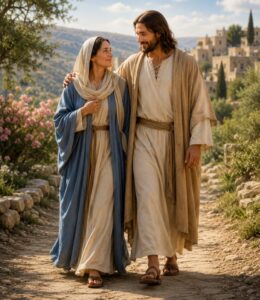
Jesus loved His mother; we should not be afraid to love her too. God chose her, filled her with grace and entrusted His only Son to her. We therefore join the words of Scripture and say: “Blessed are you among women.”
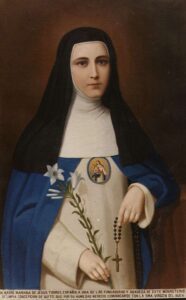
More than four hundred years ago, in a convent in Quito, Ecuador, Mother Mariana de Jesus Torres reportedly received a series of extraordinary visions of the Blessed Virgin Mary under the title Our Lady of Good Success. Mother Mariana was a Spanish Conceptionist nun who helped establish the Royal Convent of the Immaculate Conception in Quito, and beginning in 1594 she reported mystical experiences that continued over many years. What makes her story especially interesting today is that revelations attributed to her concerned a future period of serious moral and spiritual decline, particularly in the centuries that would follow.
Among the principal warnings attributed to these visions was that the light of faith would be greatly diminished, Christian morality would deteriorate, and ideas contrary to the Catholic faith would spread throughout society. For someone living around the year 1600, our modern secular world would have been almost unimaginable, yet today religion has steadily disappeared from much of public life and beliefs once accepted throughout Christian society are increasingly considered outdated or even offensive.
One of the most striking parts of the reported prophecies concerns marriage and the family. Mother Mariana was reportedly shown that the Sacrament of Matrimony would come under severe attack and that laws and customs would undermine the Christian understanding of marriage. Four centuries later, divorce has become commonplace, marriage rates have declined, cohabitation outside marriage is widely accepted, many children grow up without both biological parents in the home, and the very meaning of marriage has become the subject of intense cultural disagreement. These similarities do not by themselves prove supernatural prophecy, but they certainly help explain why Catholics continue to find the visions remarkable.
The warnings also concerned difficulties within the Church itself. Accounts associated with Mother Mariana describe a future spiritual crisis involving priests and religious, declining vocations, irreverence toward the Sacraments, moral corruption and confusion among the faithful. Catholics living today have witnessed the terrible clergy sexual-abuse scandals, declining Mass attendance in much of the Western world, shortages of priests and religious vocations, and widespread disagreement and confusion about Catholic teaching. It is therefore understandable that a Catholic reading these centuries-old warnings might ask whether Mother Mariana was shown something about the age in which we are now living.
Yet the visions were not simply warnings of disaster. The darkness was not to last forever. The accounts associated with Our Lady of Good Success also speak of an eventual spiritual restoration and renewal of the Catholic faith, with devotion to the Blessed Virgin Mary having an important place in that renewal. Christian prophecy is not intended merely to frighten us or encourage us to search for signs of catastrophe; its purpose is to call people back to God.
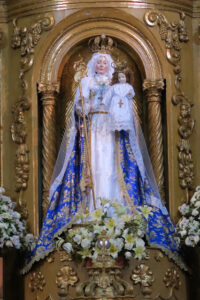
What Has the Catholic Church Said?
The devotion to Our Lady of Good Success has enjoyed ecclesiastical recognition in Quito for centuries. The devotion was supported by the local bishop in Mother Mariana’s time, and the statue of Our Lady of Good Success has continued to be publicly venerated. In 1986, Archbishop Antonio González of Quito opened Mother Mariana’s cause for beatification, and in 1991 the church associated with the devotion was designated a Marian shrine and the image received a canonical coronation.
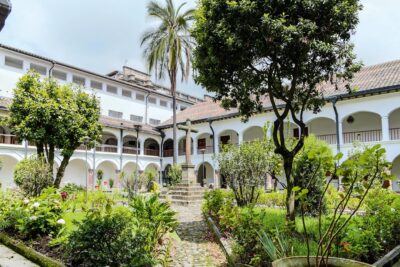
Monastery of the Immaculate Conception, Quito, Ecuador
However, an important distinction should be made. Church recognition of a Marian devotion, shrine or image does not necessarily constitute a formal declaration that every vision, prophecy or quotation attributed to Mother Mariana is of supernatural origin. Catholic commentators have noted that a canonical coronation recognizes devotion to an image but does not by itself authenticate an apparition. There are also historical questions concerning how some of the detailed prophecies were preserved and transmitted through the centuries.
Catholics therefore may take these reported revelations seriously while remembering that they remain private revelation. They do not have the authority of Sacred Scripture or the doctrines of the Catholic faith, nor is a Catholic required to believe them. This distinction actually makes the similarities between the reported prophecies and our own times more interesting, because we can examine them without claiming more certainty than the Church itself requires.
Mother Mariana died in 1635, centuries before television, the Internet, modern secularism and the social revolutions that transformed Western civilization. Yet the warnings associated with her visions concern the weakening of faith, corruption of morals, attacks upon marriage and family life, difficulties involving priests and religious, confusion among believers and the eventual need for spiritual renewal.
Perhaps, however, the most important question is not whether Mother Mariana accurately described the twenty-first century, but what Catholics should do if we recognize our own world in these warnings. The answer is the same one Christianity has given during every difficult period in its history: remain faithful to Christ, receive the Sacraments, pray, defend marriage and family life, teach the faith to our children and grandchildren, and never surrender to despair.
Mother Mariana’s message ultimately is not that evil will triumph. It is a warning accompanied by hope. Christ promised that He would remain with His Church, and periods of darkness have come and gone throughout Christian history. More than four centuries after Mother Mariana lived, perhaps the question her remarkable story leaves for each of us is simply this:
When faith becomes difficult, will we remain faithful?
Our mission statement is to motivate people to pray and to be
Christian examples in their work, home and with others, for
those needing the Light in a world of Darkness.