
Blessings to All
By: Richard Pickard
Sometimes we forget how easy it is to lose our spiritual compass. The world is a beautiful place God created for us to live in. But it is also a world where Satan prowls around stealing the seeds of eternal life that are in all of our souls.
The parable in Luke’s Gospel 8:11-12 is Jesus telling us to be aware and to resist the temptations put in our path by the devil.
God is constantly giving us His Word each day to help us in the fight against the temptations of the world that can lead us down the path of destruction.
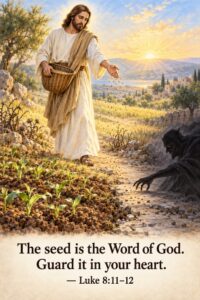
The seed is God’s Word. It contains the promise of eternal life, but a seed must be received, protected and allowed to grow. Satan cannot take away God’s love or defeat His power. What he tries to do is distract us, deceive us and persuade us to turn away from the truth before God’s Word can take root in our lives.
This is why Saint Peter warns us: “Be sober and vigilant. Your opponent the devil is prowling around like a roaring lion looking for someone to devour.” 1 Peter 5:8
The devil often works quietly. He may use pride, resentment, discouragement, temptation or an excessive attachment to the things of this world. He wants us to become so occupied with daily concerns that we gradually stop praying, stop listening to God and lose sight of our eternal destination.
God, however, never abandons us. He continually gives us His Word, His grace and the Sacraments to strengthen us in the struggle against temptation. Through prayer, Scripture, the Holy Eucharist and the Sacrament of Reconciliation, Christ nourishes the seed of faith within us.
God’s grace is always offered, but it does not destroy or override our human freedom. God created us with the ability to choose. He invites us to love Him, follow Him and accept His grace, but He does not force us to do so. Love cannot be forced; it must be freely given.
This means that we have a responsibility to cooperate with God’s grace. We must guard what He has planted within us. When temptation comes, we can turn toward Christ or away from Him. When we fall into sin, we can remain separated from God or humbly return to Him through repentance and confession.
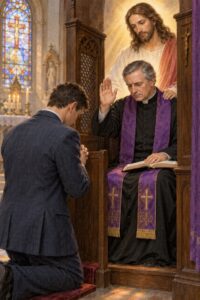
Christ gave us the Sacrament of Reconciliation for exactly this reason:
Jesus said to them again, ‘Peace be with you. As the Father has sent me, even so I send you.’ And when he had said this, he breathed on them, and said to them, ‘Receive the Holy Spirit. If you forgive the sins of any, they are forgiven; if you retain the sins of any, they are retained.’ John 20:21-23
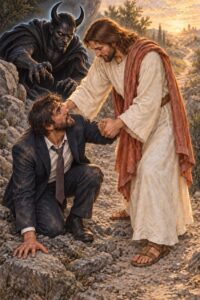
Satan may tempt us, but he cannot compel us to sin. He may place obstacles in our path, but he cannot prevent us from calling upon Jesus. The final choice remains ours. Every time we pray, resist temptation, forgive someone or perform an act of charity, we allow the seed of God’s Word to grow more deeply within us.
We must also be careful not to become discouraged when we fail. Discouragement can itself become a spiritual trap. Christ knows our weakness, and His mercy is greater than our sins. He does not ask us never to stumble; He asks us to rise again, trust in His mercy and continue walking toward Him.
Our spiritual compass must always point toward Jesus Christ. The world may offer many attractive roads, but only Christ leads us safely home. He is the Way, the Truth and the Life.
Let us therefore protect the seed God has placed within our hearts. Let us nourish it through prayer, Scripture, the Sacraments and works of love. Let us remain watchful without becoming fearful, because Christ has already conquered sin and death.
The devil may prowl around us, but he does not have the final word. The final word belongs to Jesus Christ.
May God bless you and your families, strengthen your faith and keep your spiritual compass always pointed toward Heaven.
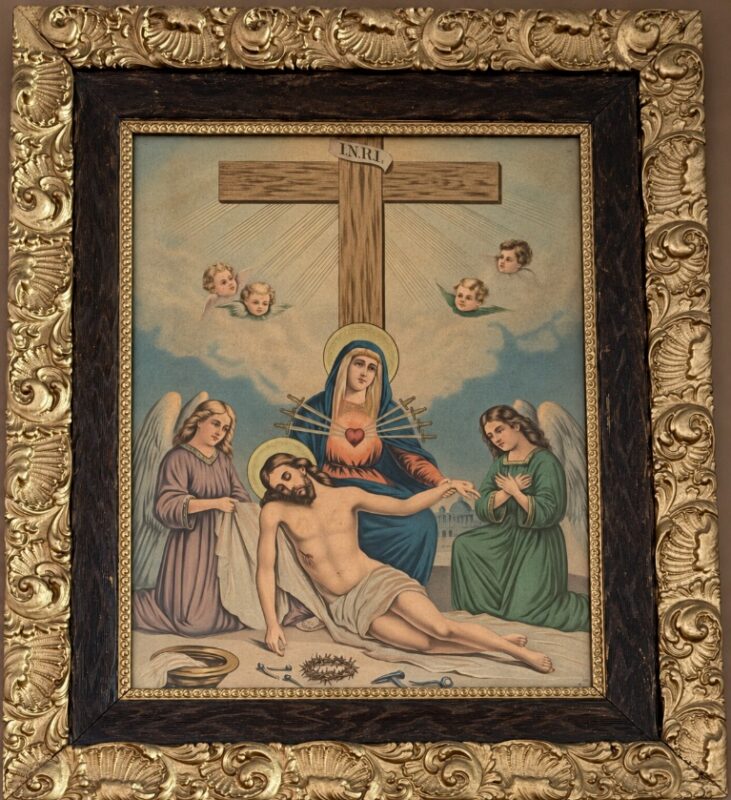
From the birth of Jesus to His burial, Mary’s life was filled with extraordinary joy—but also profound suffering. The Seven Sorrows of the Blessed Mother recall seven moments when her heart was pierced by grief.
Mary could not remove the suffering of her Son, yet she never abandoned Him. She remained faithful when she did not understand, courageous when danger surrounded her, and present when almost everyone else had fled.
- The Prophecy of Simeon
When Mary and Joseph presented the infant Jesus in the Temple, Simeon recognized Him as the promised Messiah. But he also warned Mary: “You yourself a sword will pierce.” From that moment, Mary knew that her Son’s mission would bring both salvation and suffering.
Luke 2:25–35
- The Flight into Egypt
King Herod sought to kill the Child Jesus. Warned by an angel, Joseph took Mary and Jesus and fled into Egypt. Mary became a refugee, carrying her infant Son into an unfamiliar land while escaping a murderous king.
Matthew 2:13–15
- The Loss of the Child Jesus
When Jesus was twelve years old, Mary and Joseph discovered that He was missing while they were returning from Jerusalem. For three anxious days they searched for Him before finding Him in the Temple. Mary experienced the terrible fear of a mother who does not know whether her child is safe.
Luke 2:41–50
- Mary Meets Jesus on the Road to Calvary
As Jesus carried the Cross through the streets of Jerusalem, Mary saw her Son wounded, mocked and condemned. Their eyes must have met with a love too deep for words. She could not lift the Cross from His shoulders, but her presence told Him that He was not alone.
- Mary Stands Beneath the Cross
Mary remained at Calvary while Jesus was crucified. She heard His words, witnessed His suffering and watched Him surrender His life. From the Cross, Jesus entrusted Mary to the beloved disciple, and through him to all believers: “Behold, your mother.”
John 19:25–30
- Mary Receives the Body of Jesus
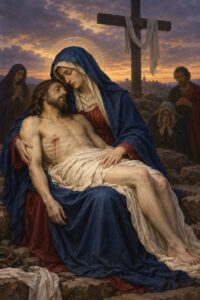
After Jesus was taken down from the Cross, His body was placed in His mother’s arms. The hands that once held Him as an infant now held Him in death. This sorrowful image, known as the Pietà, expresses both the depth of a mother’s grief and the immeasurable cost of our redemption.
- Jesus Is Placed in the Tomb
Mary accompanied her Son to the place of burial. The stone was rolled across the entrance, and she departed carrying a grief beyond description. Yet even in that darkness, God’s promise had not failed. The tomb would not have the final word.
Luke 23:50–56
A Mother Who Understands Our Sorrows
The Seven Sorrows do not ask us to remain in sadness. They remind us that Mary understands human grief: fear for a child, forced separation, helplessness, injustice, suffering and death.
She teaches us that faith does not mean we will never suffer. Faith means continuing to trust God even when our hearts are broken and we cannot yet see what He is doing.
Mary stood beneath the Cross because love does not run away from suffering. She remained faithful through the darkest hour—and lived to witness the joy of the Resurrection.
When sorrow enters our own lives, we may turn to the Blessed Mother and pray:
Mother of Sorrows, remain close to us in our trials. Teach us to stand faithfully beside those who suffer, to trust God when the way is dark, and to remember that beyond every Calvary lies the promise of resurrection. Amen.
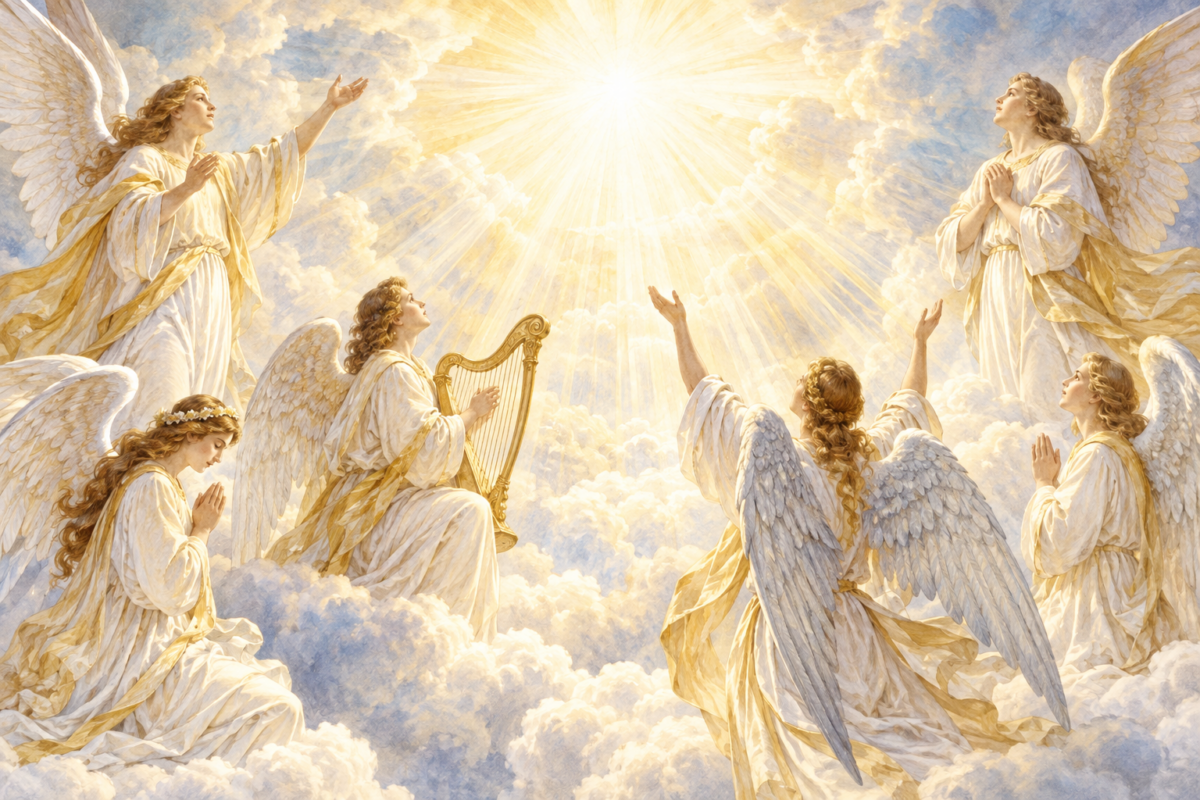
With their whole beings, the angels are servants and messengers of God.
Angels are often pictured as gentle figures with wings, but the angels described in Sacred Scripture are powerful spiritual beings created by God. They possess intelligence and free will, but they have no physical bodies. They are not deceased human beings who became angels.
The word angel means messenger. Throughout salvation history, God has sent angels to guide, protect, warn, strengthen, and deliver His people. An angel announced the birth of Christ to the shepherds. Angels ministered to Jesus after His temptation, strengthened Him during His agony in the garden, and announced His Resurrection.
The Nine Choirs of Angels
Catholic tradition arranges the angels into nine choirs. Scripture names these different orders, although it does not give us a complete description of their duties. The traditional arrangement helps us understand the beautiful order of the angelic world. This ordering comes to us from the early Christian writer known as Pseudo-Dionysius, and St. Thomas Aquinas taught it in his Summa Theologiae.
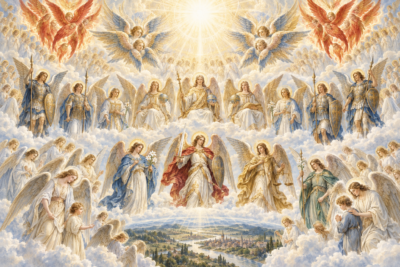
Catholic tradition speaks of nine choirs serving God in perfect order.
Seraphim: Stand closest to God’s throne, burning with love and continually praising Him: Holy, holy, holy. Their name means the burning ones.
Cherubim: Are associated with divine wisdom and the protection of sacred things. God placed cherubim at the entrance to Eden, and their images appeared upon the Ark of the Covenant.
Thrones: Represent God’s justice, authority, and peaceful rule over creation.
Dominions: Are traditionally understood to direct the work of the lower choirs so that God’s commands are faithfully carried out.
Virtues: Are associated with divine strength, courage, and the wonders through which God’s power is revealed.
Powers: Are spiritual warriors who resist evil and help preserve God’s order against the rebellious angels.
Principalities: Are traditionally associated with the spiritual care of nations, communities, and the Church.
Archangels: Receive important missions affecting humanity. Scripture names Michael, the defender against Satan; Gabriel, who announced the Incarnation to Mary; and Raphael, the healer and traveling companion in the Book of Tobit.
Angels: Are the choir most directly involved with individual human lives. From this choir are commonly understood to come our Guardian Angels.
Your Guardian Angel
“Their angels in heaven always see the face of my Father who is in heaven.” Matthew 18:10
The Church teaches that human life is surrounded by the watchful care and intercession of the angels. Our Guardian Angel does not replace Jesus, the Holy Spirit, or our own free will. He quietly helps us recognize what is good, resist temptation, avoid spiritual danger, and draw nearer to God.
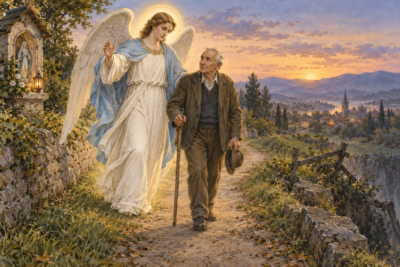
From infancy to death, human life is surrounded by angelic care and intercession.
We should never worship angels. Worship belongs to God alone. We may, however, honor the holy angels, thank God for their assistance, and ask them to pray for and protect us.
Our Guardian Angel is with us during ordinary days, difficult decisions, illness, temptation, and prayer. The Church even asks the angels to accompany the faithful at the hour of death and lead them toward Heaven.
Although our eyes cannot see them, we are not traveling through life alone. God has surrounded His children with heavenly servants whose entire mission is to obey Him and help lead souls toward eternal life.
Angel of God, my guardian dear,
to whom God’s love commits me here,
ever this day be at my side,
to light and guard, to rule and guide. Amen.
Catholic teaching: Catechism of the Catholic Church, paragraphs 328-336 and 350-352.
Our mission statement is to motivate people to pray and to be
Christian examples in their work, home and with others, for
those needing the Light in a world of Darkness.