
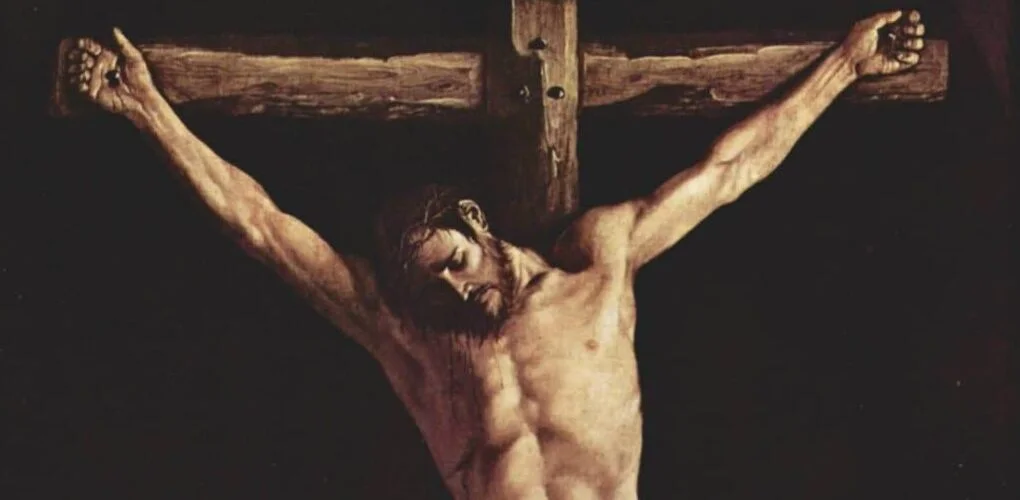
Bringing Light Into a World of Darkness
The Eucharist: More Than a Meal
The Tabernacle Is Never Empty
The Vision of St Don Bosco
What I’ve Learned
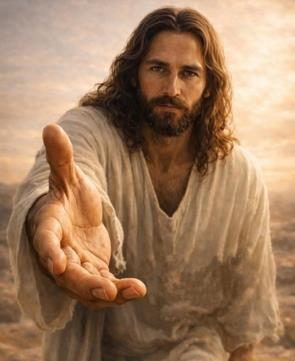
THOUGHT FOR TODAY
- Out of the depths I cry to you, LORD;
- Lord, hear my voice. Let your ears be attentive to my cry for mercy.
- If you, LORD, kept a record of sins, Lord, who could stand?
- But with you there is forgiveness, so that we can, with reverence, serve you.
- I wait for the LORD, my whole being waits, and in his word I put my hope.
- I wait for the Lord more than watchmen wait for the morning, more than watchmen wait for the morning.

The Eucharist: More Than a Meal—The Living Sacrifice of Calvary
When Jesus gathered with His Apostles in the Upper Room on the night before He died, was He simply sharing one final meal with His closest friends? Or was He preparing them—and every generation that would follow—to enter into the very mystery of His saving sacrifice on Calvary?
The answer is found in the words Jesus Himself spoke:
“This is My Body, which will be given up for you… This is the chalice of My Blood… Do this in memory of Me.”
Christians indeed share a sacred meal. At Holy Communion we receive the true Body, Blood, Soul, and Divinity of Jesus Christ. Yet before the Eucharist is our heavenly food, it is first the sacrifice of Christ made sacramentally present upon the altar. We do not gather merely around a table. We gather before the altar of the Lamb of God, who takes away the sins of the world.
Every Mass is an invitation to stand at the foot of the Cross with Our Blessed Mother and St. John. Though our eyes see only bread and wine, faith sees what heaven sees—the one eternal sacrifice of Jesus Christ offered for the salvation of the world.
The Catechism of the Catholic Church beautifully explains this mystery in paragraphs 1365–1367.
CCC 1365 teaches that the Eucharist is a sacrifice because it is the memorial of Christ’s Passover, making present the Body and Blood that He offered for the forgiveness of our sins.
CCC 1366 explains that the Eucharist represents and applies the fruits of Christ’s one sacrifice on Calvary for our redemption.
CCC 1367 declares that the sacrifice of the Cross and the sacrifice of the Eucharist are one single sacrifice. The Victim is the same. The Priest is the same. Only the manner of offering is different—bloody upon Calvary and unbloody upon the altar.
This is one of the most beautiful truths of our Catholic faith.
Jesus dies only once. The suffering of Calvary is never repeated. Yet because Christ is risen, glorified, and eternal, His one sacrifice is made sacramentally present at every Holy Mass. Christ is not sacrificed again; rather, His one perfect sacrifice transcends time and is made present to every generation.
How moving it is to realize that the same Jesus who stretched out His arms upon the Cross now stretches out His hands to feed us with His own Body and Blood.
His words spoken nearly two thousand years ago continue to echo through every Catholic church in the world:
“Do this in memory of Me.”
Every Catholic should leave Mass with the profound realization that he has not merely attended a religious gathering but has been drawn into the saving mystery of Calvary itself. The sacrifice is not repeated—it is made present. The altar is united to the Cross, and from that altar comes the Bread of Life that nourishes our souls and strengthens us for our journey toward Heaven.
The Apostles celebrated the Last Supper before witnessing the Crucifixion. They could not yet fully understand the depth of Christ’s words: “This is My Body… This is My Blood.” We stand at Mass after the Resurrection, knowing that those sacred words pointed directly to Calvary and continue to bring its saving power into our lives today.
The faith of the Catholic Church did not develop centuries later. It was handed down directly from the Apostles themselves.
One of the clearest witnesses is St. Ignatius of Antioch (A.D. 35–107). Ignatius personally knew St. Polycarp, who had himself been instructed by St. John the Apostle. Thus, Ignatius belonged to the generation immediately following the Apostles and preserved the faith they had entrusted to the Church.
Ignatius became the third Bishop of Antioch after St. Peter being the first. On his journey to Rome, where he would willingly suffer martyrdom for Christ, he warned against those who denied both the true humanity of Jesus and the Real Presence of Christ in the Eucharist. He wrote:
“They abstain from the Eucharist… because they do not confess that the Eucharist is the flesh of our Savior Jesus Christ.”
These remarkable words were written around A.D. 107—only a few years after the death of St. John. Christianity was still living in the shadow of the Apostles. There had not been centuries for a new doctrine to arise. Ignatius simply proclaimed the faith he had received.
Another powerful witness is St. Justin Martyr (A.D. 100–165). In describing the Mass to the Roman Emperor around A.D. 155, Justin explained:
“We do not receive these as common bread and common drink… this food is both
the flesh and blood of that incarnate Jesus.”
Justin’s many writings and his description of the Sunday Mass should be instantly recognizable to all of us Catholics today. The readings from Scripture, the homily, the prayers, the Eucharistic Prayer, and Holy Communion all testify that the Church of the second century celebrated the same sacred mysteries we celebrate today.
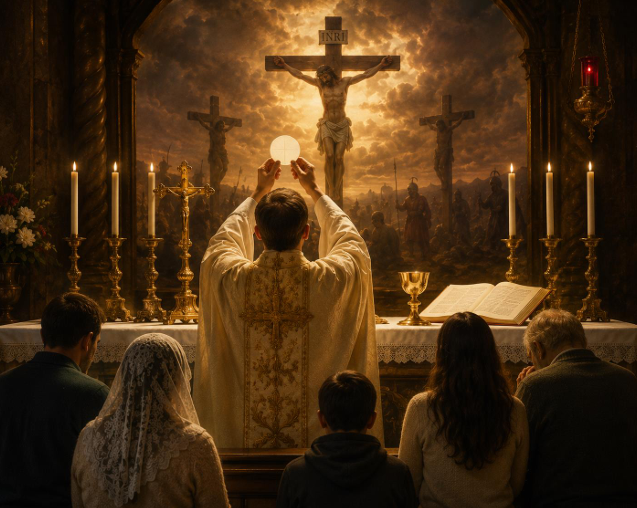
If the earliest Christians had believed the Eucharist was merely a symbol, we would expect at least some of those closest to the Apostles to have taught such a belief. Instead, from the very beginning, they consistently proclaimed that the Eucharist is truly the Body and Blood of Christ and that the Holy Mass is the sacramental making present of Christ’s one saving sacrifice.
Their testimony reaches across the centuries and joins the voice of the Church today, inviting every Catholic to approach the altar with reverence, gratitude, and awe.
May we never allow the Holy Mass to become ordinary in our eyes. Every time the bells ring at the Consecration, Heaven touches earth. Angels adore. Christ comes to us. The Savior who died for us on Calvary offers Himself to us in love, inviting us to receive Him with hearts that are humble, repentant, and filled with faith.
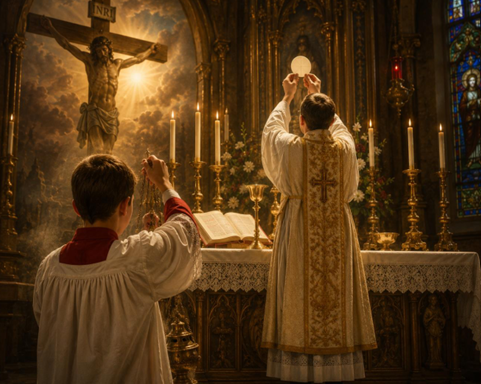
May every Holy Communion draw us closer to Jesus, deepen our love for His Church, and
prepare us for the eternal banquet where we shall one day behold Him face to face.
“O Sacrament Most Holy, O Sacrament Divine, all praise and all thanksgiving be
every moment Thine.”
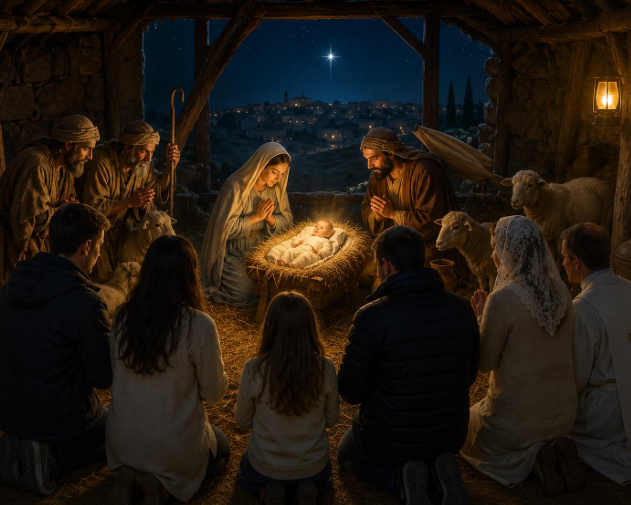
The next time you kneel before the tabernacle, remember that you are not kneeling before a symbol. You are kneeling before the same Jesus whom the shepherds adored in Bethlehem, whom the Apostles followed through Galilee, whom Mary Magdalene embraced after the Resurrection, and whom the angels worship forever in Heaven. There is no greater place on earth to be than in His Presence.
The Tabernacle Is Never Empty
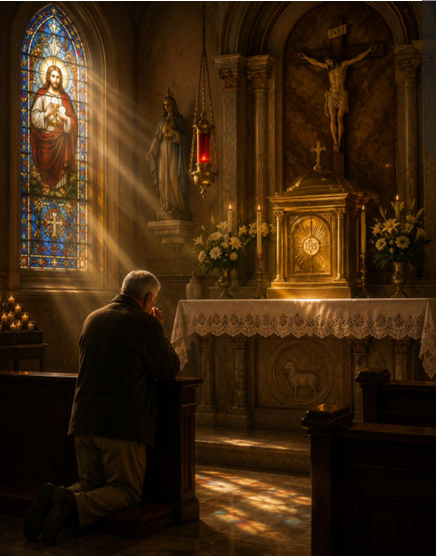
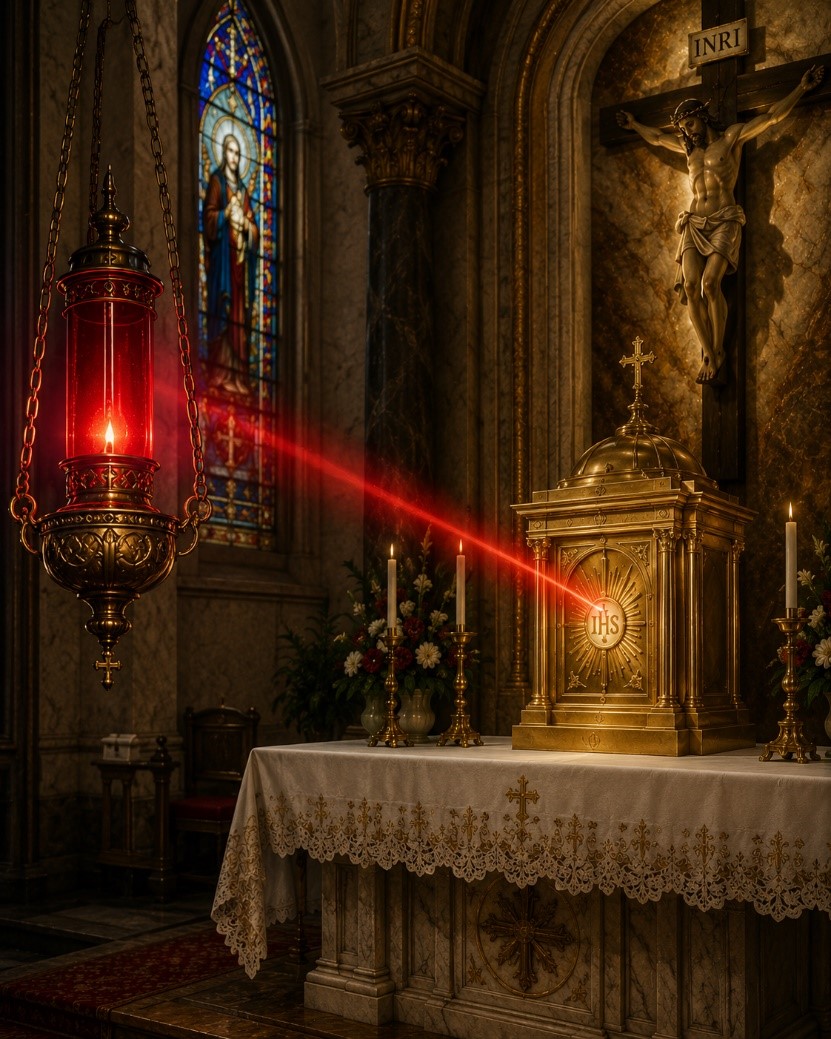
Walk into almost any Catholic church during the day and you will notice a small red sanctuary lamp burning quietly near the altar. To many, it is simply another candle. Yet to every Catholic, it proclaims one of the greatest truths on earth.
Jesus is here. Not merely remembered. Not represented. Not symbolized.
He is truly present—Body, Blood, Soul, and Divinity—in the Most Blessed Sacrament.
How often do we hurry into church, say a few quick prayers, and leave without realizing whom we have come to visit?
Imagine receiving an invitation from a dear friend whom you had not seen in years. Would you rush through the visit? Would you constantly look at your watch? Of course not. You
would cherish every moment together.
Yet the King of Kings waits for us every day in the tabernacle.
He asks for nothing more than our company.
Throughout the Gospels, we see people traveling great distances simply to be near Jesus.
The blind cried out to Him. The sick reached out to touch His garment. Children climbed into His lap. Mary of Bethany sat quietly at His feet, listening to every word He spoke.
Today, nothing has changed.
The same Jesus who walked the roads of Galilee waits patiently in every Catholic church throughout the world. He is hidden beneath the appearance of bread, but His love has not changed. His mercy has not changed. His invitation has not changed.
He is still saying:
“Come to Me, all who labor and are burdened, and I will give you rest.”
- —Matthew 11:28
Many of us spend hours worrying about our families, our health, our finances, and the future. We search for peace in many places, yet often overlook the One who is Peace itself.
The tabernacle is not empty. It is occupied by the risen Christ.
When you kneel before the tabernacle, you are not speaking into silence. You are speaking heart-to-heart with Jesus. He already knows your fears before you mention them. He knows your disappointments, your joys, your hopes, and every cross you carry.
Perhaps you don’t know what to say. That is perfectly all right. Sit quietly. Look at Him. Let Him look at you.
Many saints taught that some of the greatest moments of prayer happen in silence. St. John
Vianney once observed a farmer who spent long hours before the Blessed Sacrament. When
asked what he said to Jesus, the farmer replied: “Nothing. I look at Him, and He looks at
me.”
Could there be a more beautiful description of prayer?
In a noisy world filled with constant distractions, the tabernacle remains a place of profound peace. There, the noise of the world grows quiet, and the voice of Christ can once again be heard within the heart.
The next time you pass a Catholic church, consider stopping for just five minutes. Walk inside. Make the Sign of the Cross. Genuflect before the tabernacle. Then simply tell Jesus:
“Lord, I have come to spend a few moments with You because I know You are here.”
Those few minutes may become the most important part of your day.
One day, in Heaven, our faith will give way to sight, and we shall behold our Savior face to face. Until that glorious day, He has not left us alone. He remains with us in the Holy Eucharist, waiting patiently in every tabernacle throughout the world. The sanctuary lamp still burns. The invitation still stands.
And the tabernacle is never empty. If the Red Sanctuary Light is on, it points to Jesus being present.
The Vision of St Don Bosco Reminds Us of the Battle Against the Church
The column of the Eucharist is inscribed “Salvation of Believers”
The column of the Virgin Mary is inscribed “The Help of Christians”
St. Don Bosco is also known for his many prophetic dreams which you can read about here. His most famous dream regards future troubles for the Church and is known as the Prophecy of the Two Columns. In his words, here is the dream:
“Try to picture yourselves with me on the seashore, or, better still, on an outlying cliff with no other land in sight. The vast expanse of water is covered with a formidable array of ships in battle formation, prows fitted with sharp spear-like beaks capable of breaking through any defense. All are heavily armed with cannons, incendiary bombs, and firearms of all sorts – even books – and are heading toward one stately ship, mightier than them all. As they try to close in, they try to ram it, set it afire, and cripple it as much as possible.
“This stately vessel is shielded by a flotilla escort. Winds and waves are with the enemy. In this midst of this endless sea, two solid columns, a short distance apart, soar high into the sky: one is surmounted by a statue of the Immaculate Virgin at whose feet a large inscription reads: Help of Christians; the other, far loftier and sturdier, supports a [Communion] Host of proportionate size and bears beneath it the inscription Salvation of believers.
“The flagship commander – the Roman Pontiff [the Pope]- seeing the enemy’s fury and his auxiliary ships very grave predicament, summons his captains to a conference. However, as they discuss their strategy, a furious storm breaks out and they must return to their ships. When the storm abates, the Pope again summons his captains as the flagship keeps on its course. But the storm rages again. Standing at the helm, the Pope strains every muscle to steer his ship between the two columns from whose summits hang many anchors and strong hooks linked to chains.
“The entire enemy fleet closes in to intercept and sink the flagship at all costs. They bombard it with everything they have: books and pamphlets, incendiary bombs, firearms, cannons. The battle rages ever more furious. Beaked prows ram the flagship again and again, but to no avail, as, unscathed and undaunted, it keeps on its course. At times a formidable ram splinters a gaping hole into its hull, but, immediately, a breeze from the two columns instantly seals the gash.
“Meanwhile, enemy cannons blow up, firearms and beaks fall to pieces, ships crack up and sink to the bottom. In blind fury the enemy takes to hand-to-hand combat, cursing and blaspheming. Suddenly the Pope falls, seriously wounded. He is instantly helped up but, struck down a second time, dies. A shout of victory rises from the enemy and wild rejoicing sweeps their ships. But no sooner is the Pope dead than another takes his place. The captains of the auxiliary ships elected him so quickly that the news of the Pope’s death coincides with that of his successor’s election. The enemy’s self-assurance wanes.
“Breaking through all resistance, the new Pope steers his ship safely between the two columns and moors it to the two columns; first to the one surmounted by the Host, and then to the other, topped by the statue of the Virgin. At this point something unexpected happens. The enemy ships panic and disperse, colliding with and scuttling each other. Some auxiliary ships which had gallantly fought alongside their flagship are the first to tie up at the two columns.
“Many others, which had fearfully kept far away from the fight stand still, cautiously waiting until the wrecked enemy ships vanish under the waves. Then, they too head for the two columns, tie up at the swinging hooks, and ride safe and tranquil beside their flagship. A great calm now covers the sea.”
And in conclusion, this dream:
“Very grave trials await the Church. What we have suffered so far is almost nothing compared to what is going to happen. The enemies of the Church are symbolized by the ships which strive their utmost to sink the flagship. Only two things can save us in such grave hour: devotion to Mary and frequent Communion. Let us do our very best to use these two means and have others use them everywhere.”
Many interpret John Bosco’s vision as regarding the trials the Church has endured, and is continuing to endure, at the dawn of the third millennium; namely, rampant secularism and apostasy which has led to attacks against the Church and Her teachings. St. Don Bosco, pray for us!
I’ve Learned
By: Andy Rooney, 60 Minutes, TV (1919–2021)
I've learned -
that you cannot make someone love you.
All you can do is
be someone who can be loved.
The rest is up to them.
I've learned -
that no matter how much I care,
some people just don't care back.
I've learned -
that it takes years to build up trust,
and only seconds to destroy it.
I've learned -
that it's not what you have in your life.
I've learned -
that you can get by on charm
for about fifteen minutes.
After that, you'd better know something.
I've learned -
that you shouldn't compare
yourself to the best others can do
but to the best you can do.
I've learned -
that it's not what happens to people
that's important. It's what they do about it.
I've learned -
that no matter how thin you slice it,
there are always two sides.
I've learned -
that it's taking me a long time
to become the person I want to be.
I've learned -
that it's a lot easier
to react than it is to think.
I've learned -
that you should always leave
loved ones with loving words.
It may be the last time you see them.
I've learned -
that you can keep going
long after you think you can't.
I've learned -
that we are responsible for what we do,
no matter how we feel.
I've learned -
that either you control your attitude
or it controls you.
I've learned -
that heroes are the people
who do what has to be done
when it needs to be done,
regardless of the consequences.
I've learned -
that learning to forgive takes practice.
I've learned -
that there are people who love you dearly,
but just don't know how to show it.
I've learned -
that money is a lousy way of keeping score.
I've learned -
that my best friend and I can do anything
or nothing and have the best time.
I've learned -
that sometimes the people you expect
to kick you when you're down
will be the ones to help you get back up.
I've learned -
that true friendship continues to grow,
even over the longest distance.
Same goes for true love.
I've learned -
that just because someone doesn't love you
the way you want them to doesn't mean
they don't love you with all they have.
I've learned -
that maturity has more to do with
what types of experiences you've had
and what you've learned from them
and less to do with how many
birthdays you've celebrated.
I've learned -
that you should never tell a child
their dreams are unlikely or outlandish.
Few things are more humiliating, and
what a tragedy it would be
if they believed it.
I've learned -
that your family won't always
be there for you. It may seem funny,
but people you aren't related to
can take care of you and love you
and teach you to trust people again.
Families aren't only biological.
I've learned -
that no matter how good a friend is,
they're going to hurt you
every once in a while
and you must forgive them for that.
I've learned -
that it isn't always enough
to be forgiven by others.
Sometimes you have to learn
to forgive yourself.
I've learned -
that no matter how bad
your heart is broken
the world doesn't stop for your grief.
I've learned -
that our background and circumstances
may have influenced who we are,
but we are responsible for who we become.
I've learned -
that just because two people argue,
it doesn't mean they don't love each other.
And just because they don't argue,
it doesn't mean they do.
I've learned -
that sometimes you have to put
the individual ahead of their actions.
I've learned -
that we don't have to change friends
if we understand that friends change.
I've learned -
that two people can look
at the exact same thing
and see something totally different.
I've learned -
that there are many ways of falling
and staying in love.
I've learned -
that no matter the consequences,
those who are honest with themselves
get farther in life.
I've learned -
that your life can be changed
in a matter of hours
by people who don't even know you.
I've learned -
that even when you think
you have no more to give,
when a friend cries out to you,
you will find the strength to help.
I've learned -
that writing, as well as talking,
can ease emotional pains.
I've learned -
that the paradigm we live in
is not all that is offered to us.
I've learned -
that credentials on the wall
do not make you a decent human being.
I've learned -
that although the word "love"
can have many different meanings,
it loses value when overly used.
I've learned -
that it's hard to determine
where to draw the line
between being nice and
not hurting people's feelings
and standing up for what you believe.
I’ve learned –
Children are our future
And we should cherish them
From conception to old age.

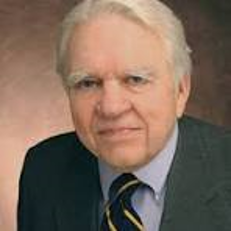
Andy Rooney,
A commentator on TV Program 60 Minutes for 33 years
The International Catholic Family Newsletter Is Published Monthly
Our mission statement is to motivate people to pray and to be
Christian examples in their work, home and with others, for
those needing the Light in a world of Darkness.